Main page>Blog>Case Studies>Case Study: How TeraFlops Automated Dynamic Pricing on a Price Aggregator
Case Studies
3.09.2025
1,122
Case Study: How TeraFlops Automated Dynamic Pricing on a Price Aggregator
Results
An automated repricing system was implemented, taking into account cost price, minimum markup, competitive positioning, and logistics expenses.
Marginal revenue meets planned targets thanks to the aggregation of data from various sources and the configuration of repricing rules that consider supplier prices, competitor prices, and the desired profit level by category.
The frequency of price updates has significantly increased, allowing for prompt responses to changes in competitors’ prices on price aggregators.
10 working hours per week have been freed up, enabling the team to redirect time to other strategic tasks.
Automation eliminated the need to hire additional staff to handle the increased volume of repricing.
Customer Background
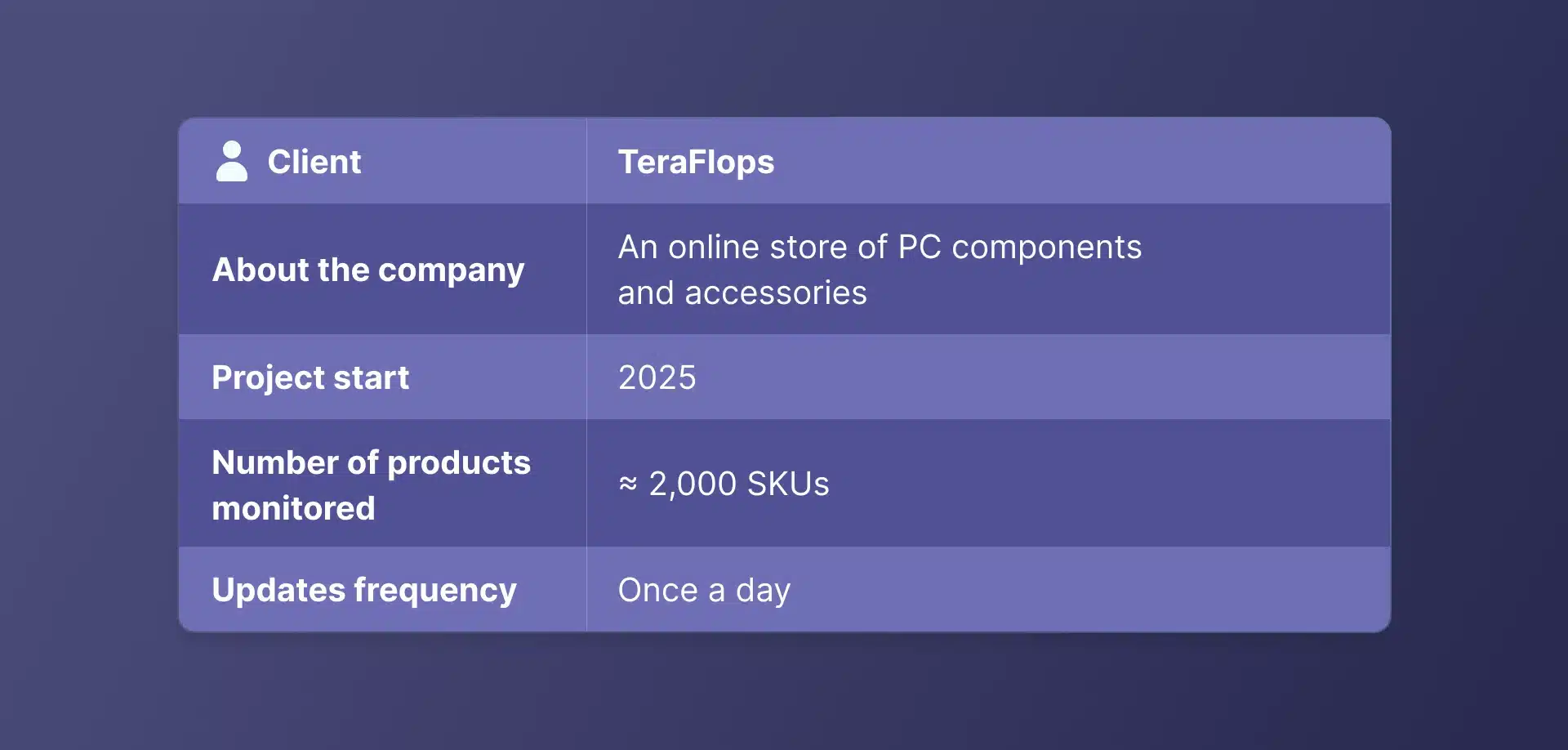
TeraFlops is a Ukrainian reseller that started operations in 2020. Initially, the company specialized in selling, assembling, and servicing personal computers. Today, TeraFlops is a team of 13 specialists working in two main areas:
sales of used components;
sales of new PC components, peripherals, and accessories.
TeraFlops’ target audience primarily purchases expensive computers and main components from large, well-known retailers, while searching for more specialized products on price aggregators. This is the niche in which TeraFlops competes successfully: thanks to its compact business structure and optimized costs, the efficient reseller can offer attractive prices for new PC components, peripherals, and accessories while maintaining the necessary level of margin and customer service.
The business is actively expanding its online presence through multiple channels:
Own website on the Prom.ua platform — the main channel, closely integrated with the price aggregator;
Marketplaces Rozetka and ALLO — channels for selling used products;
Price aggregator Hotline — the primary channel for selling new products.
Presence on Hotline also serves an important purpose — it helps increase brand awareness and attract new customers. The aggregator functions as a kind of “showcase” that drives traffic to the company’s website, as each product listing on Hotline includes a direct link to the site, encouraging users to make a purchase there. The strategy then works to generate additional sales: the customer moves from Hotline to the main website and sees an expanded assortment not available on the aggregator but potentially interesting to the target audience. This approach allows TeraFlops to differentiate itself from competitors.
The company’s positioning is built on three core principles: high-quality service with fast communication and prompt delivery (sometimes directly from the supplier), an exclusive assortment, and market-competitive prices.
Nuances of Selling on Hotline
Hotline is one of the most popular services for comparing prices among online stores in Ukraine. It is a price aggregator that collects pricing information from various sources and allows users to quickly compare offers.
The platform features both official and unofficial retailers — from major e-commerce players to small sellers. All of them compete for the buyer’s attention, with price often being the key factor in the customer’s choice.
While operating on Hotline, our client faced several key challenges:
Non-compliance with MAP/MSRP by competitors: most market participants ignore the manufacturers’ recommended retail prices, leading to price chaos.
High price discrepancies: the price difference for the same product on Hotline can exceed 20%. There were cases where our client’s purchase price for certain products was higher than the retail price offered by competitors on Hotline.
Constant assortment expansion: competitors regularly introduce new products. Sometimes, a product or brand that our client was the sole seller of yesterday appears with competitors today. These changes need to be promptly accounted for in the pricing process.
“Our prices need to be competitive. We must constantly monitor the market and adjust them. If product prices on Hotline aren’t updated for several days, serious sales issues arise immediately.”
As the business grew and the product assortment expanded from 500 to over 8,000 items, TeraFlops faced significant operational challenges that hindered further scaling:
Lack of automation: this made it impossible to respond promptly to changes in competitors’ prices on Hotline, resulting in lost profits.
Limited human resources: the team had only two employees responsible for repricing.
Labor-intensive repricing process: dozens of tabs had to be opened to manually check competitors’ prices; data had to be aggregated into a format suitable for analysis; prices and various supplier conditions (e.g., different logistics costs) needed to be analyzed.
All of this had to be aligned with the company’s margin requirements.
“One manager could process up to 500 prices, but it took the entire workday. I asked myself: is it worth keeping a person under constant stress for 25–30 thousand hryvnias when parsing costs half as much and allows us to collect all prices at once?
The most critical losses were linked to untimely price updates. In some categories, we lost up to 20–22% of marginal revenue when competitors quickly raised prices due to inflation or shortages of certain products, while we continued selling at outdated, irrelevant prices.
There were cases when, instead of the expected margin, we earned just enough to cover the marketplace commission and the manager’s salary.”
All of these challenges triggered the search for a solution that would allow the company to maintain competitiveness and profitability despite limited human resources.
The company decided to automate routine processes for price analysis and pricing, leaving only targeted decisions on specific categories and products to the team.
TeraFlops’ Tasks
Strengthen market position and brand awareness by attracting customers from Hotline.
Ensure competitiveness on the price aggregator.
Update prices on Hotline promptly.
Minimize losses from untimely product repricing.
Optimize human resources by freeing employees from routine work for more strategic tasks.
How Pricer24 Helped TeraFlops Optimize Product Repricing on Hotline
Pricer24 provides online stores with a comprehensive solution for automating product repricing — dynamic pricing. It allows prices to be automatically adjusted based on competitor and supplier prices, as well as internal data (e.g., stock levels, profit margins) and configured repricing rules.
The platform supports large SKU catalogs, complex product segmentation, and the customization of pricing strategies at the level of categories, brands, product groups, or even individual SKUs.
For TeraFlops, we customized the existing functionality to fully meet the client’s needs. This was accomplished quickly thanks to the modular nature of our platform, which can be assembled into the required solution like a constructor.
How Dynamic Pricing Works in Pricer24
Client provides data. The client shares their product catalog, list of categories and brands to monitor, competitor list, and supplier price lists (either exported to the system or accessed via supplier API). A technical specification is prepared.
Product matching. Pricer24 searches for and matches products, creating precise pairs of “client product — competitor product.”
Data collection. The platform collects prices and other parameters daily at a set interval. It gathers competitor prices for similar products, availability, and other public data such as reviews and ratings, discounts or promotions, and product positions in competitor catalogs.
Data aggregation and visualization. Pricer24 aggregates and visualizes data. Several report types are available for analysis: Price Comparison, Price Fluctuations, Price History, Assortment Analysis, and Market Analysis. The Pricer24 team configures these reports in a client-friendly format and creates dashboards tailored to daily tasks.
Pricing strategy setup. The client sets repricing rules in the technical specification. For example: “Be 1% cheaper than the lowest-price competitor, but not below a specified margin threshold.”
Generation of price recommendations. Based on the collected data and established rules, the system generates new recommended prices.
Export of calculated prices: the client receives a file (CSV, API, or other format) that can be:
Uploaded to the client’s CMS;
Transferred to ERP or pricing management systems;
Used for internal analytics or approval processes.
Data is updated according to the chosen schedule, and prices are automatically adapted based on market conditions and client-defined rules.
Implementation of Dynamic Pricing for TeraFlops
To start the project of automating repricing on Hotline for TeraFlops, we only needed:
A list of categories;
A list of competitors — the client chose to monitor five market players with a similar profile;
The client’s product feed — to transfer data to the Pricer24 system.
“The integration was extremely simple: all preparation on our side was limited to preparing the feed. This process took only one hour of a developer’s work.”
We configured the transfer of the client’s data to our system, enabling automatic retrieval of their current prices.
Daily parsing of competitor prices was set up for eight key categories.
Result: data in the system is updated automatically once a day, in line with the client’s technical specification.
Stage 2. Pricing Algorithm Development
The foundation of the entire pricing system is the product’s input cost (purchase price), provided via the feed. Based on this price, the algorithm calculates the recommended retail price using predefined rules for each category.
The primary requirement is to ensure profitability — a minimum margin is set for each item that must be maintained. For certain product categories, logistics costs are also factored into the calculation.
Another key requirement is competitiveness. The system sequentially checks whether the client’s minimum profitable price allows setting a price at the level of the first, second, third competitor, and so on. If none of the five competitors’ prices are suitable (all sell below the minimum profitable price), the system sets the price at the minimum profitable level plus 1 UAH.
In summary, all calculations are based on a combination of the following criteria:
Input product cost;
Logistics costs for specified categories;
Minimum markup to ensure profitability;
Targeting prices of the five main competitors.
Stage 3. Automating the Decision-Making Process
After launching the pricing algorithm, managers received convenient tools for working with data. A Price Comparison Report was created, accessible to the entire team and customizable to each user’s needs.
This report allows users to view parsing results — from general information about competitors to detailed breakdowns by individual products or categories. It enables quick assessment of market price dispersion and helps identify areas with potential for adjustment.
When a price adjustment is needed, the dynamic pricing module is used. It allows settings to be specified for the products to be repriced — for example, selecting a specific category or filtering products by brand or supplier. This segmentation enables pricing strategies to be tailored as precisely as possible to the characteristics of each segment.
The client’s manager sees the recommended price in the system, calculated according to the defined rules. At the same time, the client has an internal bot that retrieves supplier input prices via API and generates a priority price.
Both values are then compared — if the Pricer24 algorithm’s recommendation matches the priority price or provides a better option in terms of margin and market positioning, the manager can approve the suggestion or make adjustments.
This approach ensures a balance between automation and manual control, maintaining both accuracy and flexibility in the process.
Stage 4. Integration with Existing Systems
Currently, the repricing process works as follows: Pricer24 parses competitor prices, repricing rules are configured in the system, and then the manager downloads the algorithm-calculated prices in Excel format. This file is then imported into the client’s ERP system, where a repricing document is generated through field mapping.
This approach has proven effective but still requires manual handling. Therefore, we plan the next optimization stage — full automation via API integration. Once implemented, data from Pricer24 will automatically sync to the client’s database hourly. The system will generate recommended prices, leaving the manager only to approve them. After approval, prices will automatically update on the client’s website and synchronize with Hotline through the existing plugin.
This will eliminate all manual file download and upload operations.
Pricer24 Statistics
98%+ of products are matched daily — the system automatically identifies items available both in the TeraFlops catalog and in competitors’ catalogs within the selected categories on Hotline.
99.5% accuracy in product matching — ensuring errors in comparisons are avoided and enabling well-informed pricing decisions.
“Automating price repricing for us means freeing up resources. Now we can engage the team in other critically important tasks — for example, updating prices from smaller suppliers or maintaining up-to-date product availability on platforms, which directly affects customer loyalty. Previously, without Pricer24, we spent up to 10 hours per week solely on manual repricing, and any delay could result in a 20–22% loss of marginal revenue in certain categories. Now these risks are minimized — revenue levels are stable, and the process is fully under control.”
Request a demo to see how Pricer24 can meet your needs
Privacy policy
Your privacy is very important to us. We want your work on the Internet to be as pleasant and useful as possible, and you quite calmly used the broadest range of information, tools and opportunities that the Internet offers.
The personal information of the Members collected at the time of registration (or at any other time) is mainly used to prepare the Products or Services in accordance with your needs. Your information will not be transferred or sold to third parties. However, we may partially disclose personal information in special cases described in the “Consent with the mailing”
What data is collected on the site
At voluntary registration on reception of dispatch you send the Name and E-mail through the registration form.
What is the purpose of this data?
The name is used to contact you personally, and your e-mail for sending you mailings of newsletters, news, useful materials, commercial offers.
Your name and e-mail are not transferred to third parties, under any circumstances, except for cases related to the compliance with the requirements of the law.
You can refuse to receive mailing letters and remove your contact information from the database at any time by clicking on the unsubscribe link present in each letter.
How this data is used
With the help of these data, information on the actions of visitors on the site is collected in order to improve its content, improve the functionality of the site and, as a result, create high-quality content and services for visitors.
You can change your browser settings at any time so that the browser blocks all files or notifies you about sending these files. Note at the same time that some functions and services will not be able to work properly.
How this data is protected
To protect your personal information, we use a variety of administrative, management and technical security measures. Our Company adheres to various international control standards aimed at transactions with personal information, which include certain control measures to protect information collected on the Internet.
Our employees are trained to understand and follow these control measures, they are familiarized with our Privacy Notice, regulations and instructions.
Nevertheless, despite the fact that we are trying to protect your personal information, you too must take measures to protect it.
We strongly recommend that you take all possible precautions while on the Internet. The services and websites that we organize include measures to protect against leakage, unauthorized use and alteration of the information we control. Despite the fact that we are doing everything possible to ensure the integrity and security of our network and systems, we can not guarantee that our security measures will prevent illegal access to this information by hackers from outside organizations.
If this privacy policy is changed, you will be able to read about these changes on this page or, in special cases, receive a notification on your e-mail.