Main page>Blog>Articles>Price Analysis on Allegro for Merchants: Tools, Challenges, and Solutions
Articles
15.01.2026
491
Price Analysis on Allegro for Merchants: Tools, Challenges, and Solutions
Allegro is one of the largest marketplaces in Europe, attracting over 29.7 million visitors per month.
In Poland, around 77% of internet users shop online, and Allegro dominates this market with the vast majority of online shoppers preferring the platform. This makes Allegro a fast and effective channel for entering the Polish market and scaling sales. A telling example is the experience of Vilgain, a Czech sports nutrition manufacturer. After launching on the Allegro marketplace, Vilgain increased monthly sales by 300% in just three months, from a few hundred units to over 4,000.
In 2024, the total sales volume of all sellers on AllegroPoland exceeded PLN 60 billion (around EUR 14 billion), showing 10.8% year-over-year growth. However, it’s not only the market that is growing — the competitive pressure is growing as well.
Allegro features over 200 million products offered by more than 128,000 sellers, and the competition is intense. From small merchants to leaders in Polish e-commerce, from local distributors to international brands — all are competing for the same customers. And the main battlefield, of course, is price.
Most categories on Allegro are characterized by high price volatility. In highly competitive niches, prices can change several times a day. Those who win are the sellers who can react faster than their competitors. But fast reactions are impossible without a daily understanding of competitors’ current prices.
Merchants who systematically analyze prices are able to:
Make timely and well-reasoned repricing decisions based on up-to-date competitor prices, not intuition
Track market trends — when competitors typically reprice their products, who initiates price wars, how quickly others respond — and adapt pricing strategies to category dynamics instead of reacting chaotically after the fact
Make informed decisions about discounts, promotions, and assortment strategy
When prices change daily and your assortment includes hundreds of items, manual price comparison becomes too slow, labor-intensive, and inaccurate.
The logical solution is automation. Today, any publicly available data can be collected automatically using parsing, and Allegro prices are no exception.
A price parser is an automated tool (a “robot”) that mimics user actions. It navigates product pages and collects key data, including:
EANs and product names
Manufacturer brands
Product page URLs
Prices and stock availability
Many services offer ready-made parsers or custom development to meet your requirements. The problem with ready-made parsers is that you end up receiving data that still needs to be processed manually: filtering, sorting, matching prices, comparing them with your own. This means significant time investment (although less than manual comparison) without delivering systematic analytics.
A more advanced option is a price intelligence platform, which is a system for monitoring prices with aggregated analytics. Price intelligence platforms collect data, perform calculations (price ranking, price differences, minimum price, percentage deviation, etc.), and visualize collected data in reports and dashboards. Among the solutions offering Allegro price monitoring are Dealavo, LivePrice, Brandly360, AleMonitor.pl, Szpiegomat, and Pricer24.
Pricer24 is a price analytics platform designed for businesses operating on Allegro. The platform offers customized solutions for all types of businesses, from SMBs to enterprise-level companies. Thanks to automation and flexible analytical tools, Pricer24 significantly simplifies the work of category managers: instead of spending hours on manual price comparisons, category managers can spend less than 5 minutes per day on such tasks while getting accurate data and clear insights to support decision-making.
How Price Collection on Allegro Works and Why It’s Challenging
Unlike e-commerce websites where all products are sold by a single retailer, marketplaces feature many sellers offering the same product. Offers for the same item from different merchants are grouped on a single product page.
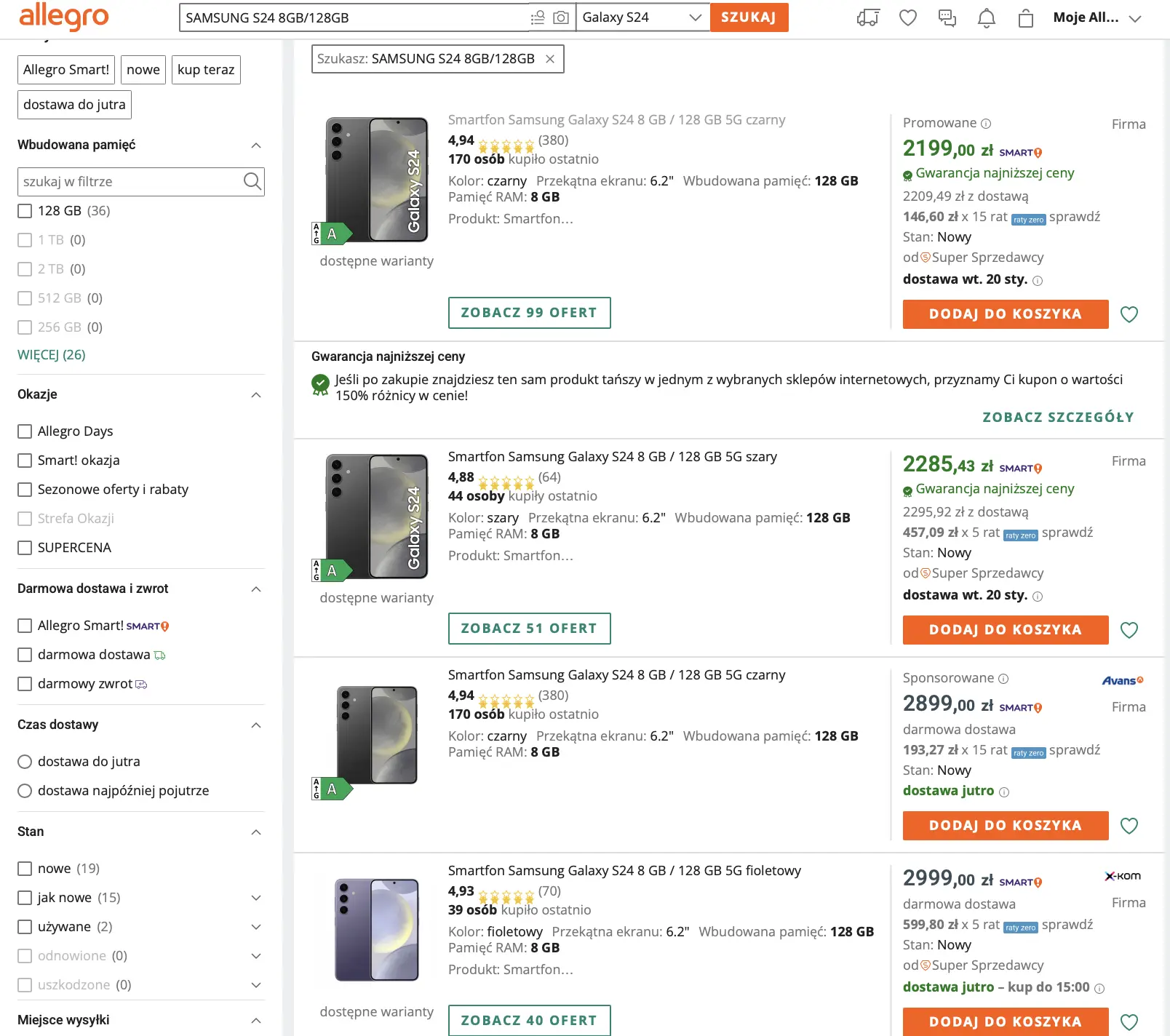
Let’s say that a buyer is searching for a Samsung Galaxy S24 smartphone. The search results display a list of products that match the query.
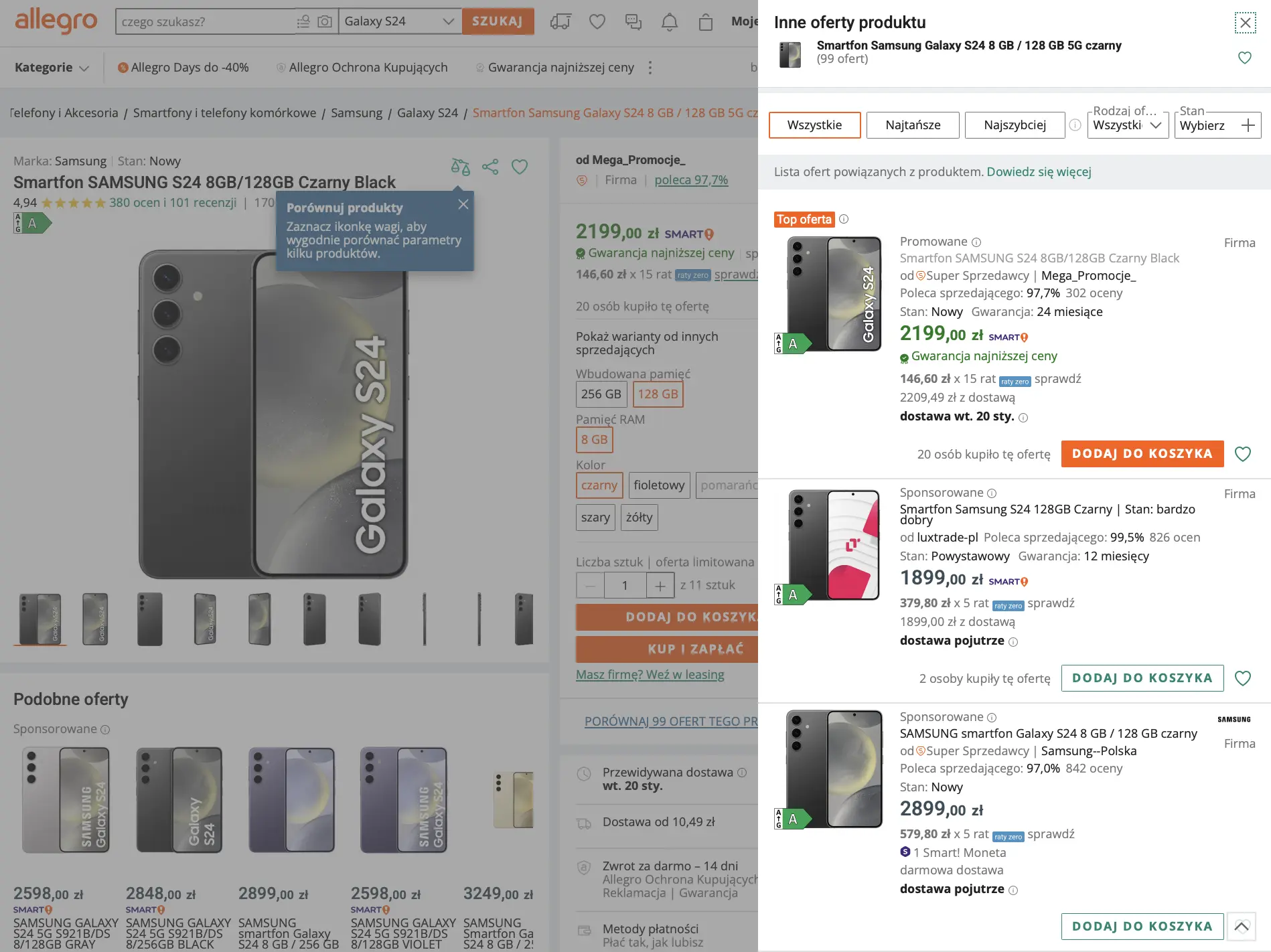
The buyer selects the desired product variant, goes to the product page, and chooses their preferred seller.
How Offers Are Grouped
According to the Allegro help center:
“In the Allegro Product Catalog, we collect and describe all products available in listings submitted by you and other sellers. We catalog products that differ from others by their attributes, i.e., key parameters such as EAN (GTIN), Brand or Manufacturer, Serial Number, Manufacturer Code, Model.”
Allegro displays a single product page to the customer, but within that page there can be 10, 20, or even 100+ offers from different sellers with varying prices. Essentially, each offer is a separate product listing on Allegro, but these offers are grouped under one product page.
In practice, this system creates numerous challenges for monitoring competitors’ prices.
First Challenge: How to Collect All Competitors’ Offers
Many assume it’s enough to monitor only a few top sellers. However, this strategy is not entirely accurate. When a buyer chooses an offer on Allegro, they consider the seller’s rating, price, and delivery terms. If an unknown merchant has a high rating and a lower price, the buyer may choose them. Therefore, analyzing only the offers of top sellers does not give a complete picture. To analyze the entire market, you need to continuously track prices of all competitors for a specific product.
How can you do this?
Approach 1: Parsing Each Offer Separately
Most price monitoring services follow a simple scheme: locate the product page, check how many offers it contains (for example, 25), and parse each offer individually using its unique URL.
The limitation of this approach is clear: If a product has an average of 20 offers and your category includes 1,000 products, you would need to parse 20,000 links. This results in enormous data volumes, long processing times, and significantly higher parsing costs.
Approach 2: Parsing the Offers Tab
The optimization seems obvious. Why not parse all offers from the Offers tab on a single product page? On average, this can reduce parsing costs by seven times.
Yet, in practice, other challenges arise. Often, sellers display the same price in the overall Offers list, whereas prices actually vary based on product variants, discounts, and promotions that are only shown on individual offer pages. For this reason, parsing each individual offer is much more accurate and helps avoid errors in the data.
But this is where new challenges begin.
Second Challenge: Quality of Grouping on Allegro
Allegro requires partners to provide an EAN (European Article Number) code and often groups products based on this code. However:
Not all sellers provide an EAN. As a result, the same product may appear under two or more product listings.
Data errors. A seller may enter an incorrect EAN or slightly modify the product name, causing the offer not to be grouped with the main product listing. Such a product won’t appear in the list of offers on the product page, but it will still be available in Allegro search. According to our estimates, such errors occur in 20–30% of cases.
Example:
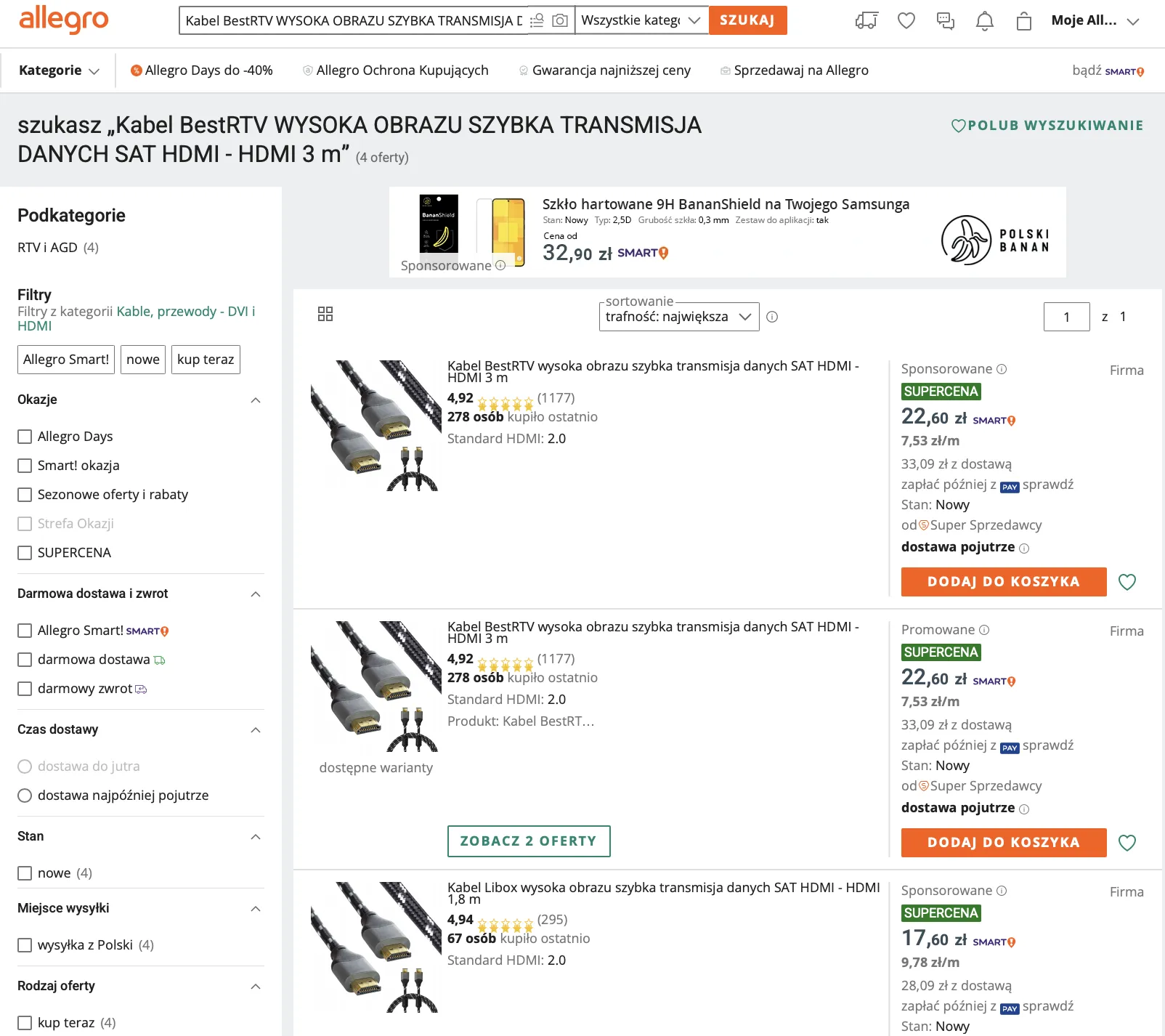
The product “Kabel BestRTV WYSOKA OBRAZU SZYBKA TRANSMISJA DANYCH SAT HDMI – HDMI 3 m” on Allegro is represented in two separate product listings.
The first listing contains two offers, and the second listing contains another two offers.It is exactly the same product, but Allegro did not group all offers under one listing. If you monitor only the offers in the first listing, you lose 50% of the market information.
Third Challenge: Product Mixing
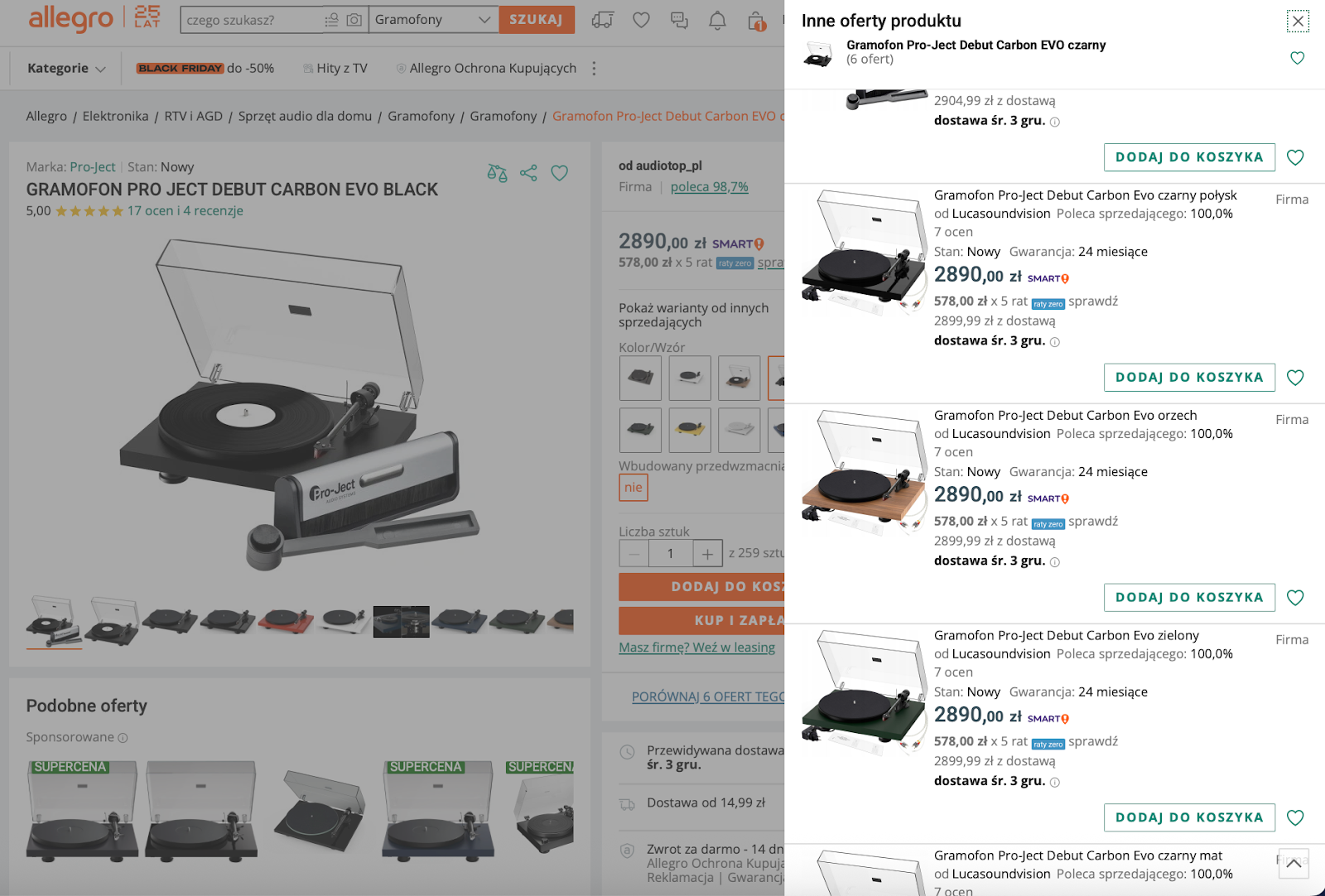
Different products can be grouped together in the Offers tab.
Example:The Offers tab for a product listing titled “GRAMOFON PRO JECT DEBUT CARBON EVO BLACK” contains an offer for a different version of the product with a wooden base.
In addition to other product versions, the Offers list often includes bundles (containing multiple products).
Let’s consider how this affects customers in two different cases:
Case 1: The buyer does not know exactly what they’re looking for. In this case, the buyer uses Allegro search or browses a category to find a product. They find different product listings and compare them.
Case 2: The buyer knows exactly what they want. In this case, the buyer searches for a specific model (with a wooden base) through Allegro search. They filter out listings with the black version in the search results. However, we know that a black listing may actually contain an offer for the wooden version, possibly at a lower price.
This is why we recommend a differentiated approach depending on the product category:
In categories with reliable grouping (laptops, smartphones, large and small home appliances, etc.), you can ignore offers that are outside the main product listing if your goal is to optimize parsing costs.
In categories with complex grouping (automotive products, pet supplies, audio equipment, accessories, etc.), it is better to search for all offers manually or semi-automatically, which increases the cost.
Fifth Challenge: Data Сonsistency
The most difficult task in monitoring prices on Allegro is maintaining data consistency, as prices and offers are constantly changing.
If your price analysis system works on the principle of “give us the links to your competitors’ products and we’ll parse the prices,” it’s a straightforward solution but with a critical drawback: it does not account for new entries. Tomorrow, a new offer may appear at a better price and from a competitor with a high rating. You perform your analysis thinking your prices are competitive, but in reality, they are not, because the system did not detect the new competitor.
What Your Analytics Will Look Like if You Ignore These Risks
Each approach to collecting and matching data has its own advantages and limitations. Understanding them will help you choose the optimal strategy for your business.
Data Collection Approach
What You Get
What You Don’t See
Risk
Parsing products by links (you provide the price monitoring service with links to competitors’ products on Allegro)
Price list from competitors you know at the time of the first parsing run
New competitors that appeared on the market yesterday; better prices from unknown sellers with high ratings
Loss of sales you may not even be aware of
Parsing all offers within a specific product listing
List of all prices (offers) from the product page; average ~7x savings on parsing costs; automatic detection of new offers within the group
The same product may be sold in 2–3 other listings on Allegro; these listings may have higher or lower prices
You don’t see the full market share and set prices based on incomplete information
Search + parsing all found listings
Maximally complete market data; all listings for the product; all offers in each listing; new competitors detected automatically
—
Minimal risk, most accurate data, but highest cost
Approaches to Collecting Prices on Allegro
Matching Approach
Advantages
Limitations
Risk
Automatic matching (like on Allegro)
Quick product matching without human involvement
Comparisons may be incorrect: white product matched with black, single item matched with a bundle
Loss of margin or sales due to decisions based on incorrect data
Manual matching
Maximum matching accuracy; full control over data quality
High labor costs; requires an experienced matching team
Most accurate approach, but also the most expensive; optimal for premium segments with complex product differentiation
Semi-automatic matching with manual validation
Balance between speed and accuracy
Depends on the quality of algorithms for rechecking links (“your product = competitor’s product”)
Optimal price/quality ratio for most businesses
Approaches to Product Matching
Pricer24 Solution for Price Analysis on Allegro
At Pricer24, we understand all the challenges of parsing Allegro and offer a flexible approach depending on your category and budget:
Option 1: Getting Maximally Complete Data (Premium Approach)
For clients with a sufficient budget, the optimal solution looks like this:
Once a month, search for products via Allegro search to find all listings for each product.
Split each listing into individual offers and parse them separately.
Manually match each offer to your product.
Periodically check for the appearance of new offers.
Result: Maximally complete, high-quality, and accurate data
Option 2: Parsing from the Offers Tab + Post-processing
To optimize the budget:
Collect all offers from a single listing instead of parsing each offer individually.
Have Pricer24 automatically match offers, similar to Allegro’s approach.
Review and adjust matching where the algorithms detect anomalies.
Example with black and white speakers:We parse the Offers tab for white speakers. The system automatically identifies the black versions among them. We collect the price from the black product listing but match it to the white product in the client’s catalog.
In this approach, post-processing of matching is required. Each offer needs to be rechecked to determine: Is it really the same product? Is it a bundle? And so on.
There are several ways to ensure matching quality:
Full manual verification: Check everything by hand (maximum accuracy, higher cost)
Selective verification: Check only where the algorithms suggest alternative matches (balance of accuracy and cost)
Differentiated approach: For complex and/or critical categories, match everything manually from the start; for simple categories, match automatically and selectively recheck
The more manual rechecking is done, the higher the service cost for the client. An alternative solution is for the client to verify automatic matches themselves. In this case, we provide access to the matching tool in the admin panel and conduct a training session on how it works.
There are many possible collaboration options — we are flexible and always adapt to the client’s needs and capabilities to offer the optimal data collection strategy.
7 Advantages of Pricer24
Flexible Approach
We don’t impose a standard set of features — the system adapts to your categories, assortment, market specifics, and internal business processes.
Deep E-commerce and Allegro Expertise
We have proven experience monitoring prices on marketplaces for various sellers. Working with global brands and retailers, we understand the mechanics of Allegro and the specifics of product categories in Poland.
Professional Product Matching
Accurate product matching is critical for high-quality price analytics. At Pricer24, this process combines technology and human expertise.
We have our own technological capabilities: algorithms for automatic matching and tools for quickly identifying potential inconsistencies.
In addition, we have a large matching team that manually verifies, refines, and corrects matches, improves algorithm performance, and eliminates errors.
All of this is governed by internal quality control processes to ensure businesses receive the most accurate data, even in the most complex categories.
Data Update Frequency
We can update data from 1 to 20 times per day, depending on your category specifics and market dynamics.
Transparency and Business Integrity
Our collaboration model ensures clients clearly understand what they’re paying for. There are no hidden fees or unexpected cost increases. All terms are fixed at the start, and pricing is transparent and predictable.
Scalability — The Solution Grows with Your Business
Pricer24 works with companies that have 500 SKUs as well as those with 100,000+ products. The system can scale to accommodate new categories, competitors, and sales channels: e-commerce sites, marketplaces, mobile apps. As your business grows, the system scales while maintaining operational stability and fast data updates.
Dedicated Manager and Polish-Language Technical Support
Each client receives a personal manager who oversees the project from launch to scaling. Our technical support team speaks Polish and understands the specifics of the local market.
Dynamic Pricing: Automating Product Repricing on Allegro
Dynamic pricing is the automatic repricing of products based on competitor and supplier prices, as well as daily market price changes.
The Pricer24 dynamic pricing system allows you to automatically update the prices of your products on Allegro.
To implement this, we need:
Your purchase prices
The desired margin for your categories or specific product groups
Rules for responding to competitor price changes and any exceptions for individual SKUs or categories
Next, we configure the dynamic pricing module. The system tracks current competitor prices, automatically compares your offers with those of competitors on Allegro, analyzes competitors’ pricing, and adjusts your pricing according to the predefined rules.
Pricer24’s dynamic pricing on Allegro ensures:
Timely response to market fluctuations
Maintenance of target margins
Competitiveness without manual oversight
Prevention of undercutting or excessive price increases
Conclusion
Price monitoring on Allegro is a complex task that requires an understanding of the platform’s business logic, accurate data parsing, and continuous verification of matches and data consistency. Not every price intelligence solution can meet these challenges.
This is why you should look not only for a tool that collects price data but for a strategic partner who understands the specifics of Allegro and can help you choose the optimal way to achieve your business goals.
Ready to get the real picture of your competitive position on Allegro? Contact us and we will:
Analyze the specifics of your category
Show you the difference between surface-level and deep monitoring for your own products
Propose an optimal price monitoring configuration for your business needs
Request a demo to see how Pricer24 can meet your needs
Privacy policy
Your privacy is very important to us. We want your work on the Internet to be as pleasant and useful as possible, and you quite calmly used the broadest range of information, tools and opportunities that the Internet offers.
The personal information of the Members collected at the time of registration (or at any other time) is mainly used to prepare the Products or Services in accordance with your needs. Your information will not be transferred or sold to third parties. However, we may partially disclose personal information in special cases described in the “Consent with the mailing”
What data is collected on the site
At voluntary registration on reception of dispatch you send the Name and E-mail through the registration form.
What is the purpose of this data?
The name is used to contact you personally, and your e-mail for sending you mailings of newsletters, news, useful materials, commercial offers.
Your name and e-mail are not transferred to third parties, under any circumstances, except for cases related to the compliance with the requirements of the law.
You can refuse to receive mailing letters and remove your contact information from the database at any time by clicking on the unsubscribe link present in each letter.
How this data is used
With the help of these data, information on the actions of visitors on the site is collected in order to improve its content, improve the functionality of the site and, as a result, create high-quality content and services for visitors.
You can change your browser settings at any time so that the browser blocks all files or notifies you about sending these files. Note at the same time that some functions and services will not be able to work properly.
How this data is protected
To protect your personal information, we use a variety of administrative, management and technical security measures. Our Company adheres to various international control standards aimed at transactions with personal information, which include certain control measures to protect information collected on the Internet.
Our employees are trained to understand and follow these control measures, they are familiarized with our Privacy Notice, regulations and instructions.
Nevertheless, despite the fact that we are trying to protect your personal information, you too must take measures to protect it.
We strongly recommend that you take all possible precautions while on the Internet. The services and websites that we organize include measures to protect against leakage, unauthorized use and alteration of the information we control. Despite the fact that we are doing everything possible to ensure the integrity and security of our network and systems, we can not guarantee that our security measures will prevent illegal access to this information by hackers from outside organizations.
If this privacy policy is changed, you will be able to read about these changes on this page or, in special cases, receive a notification on your e-mail.